
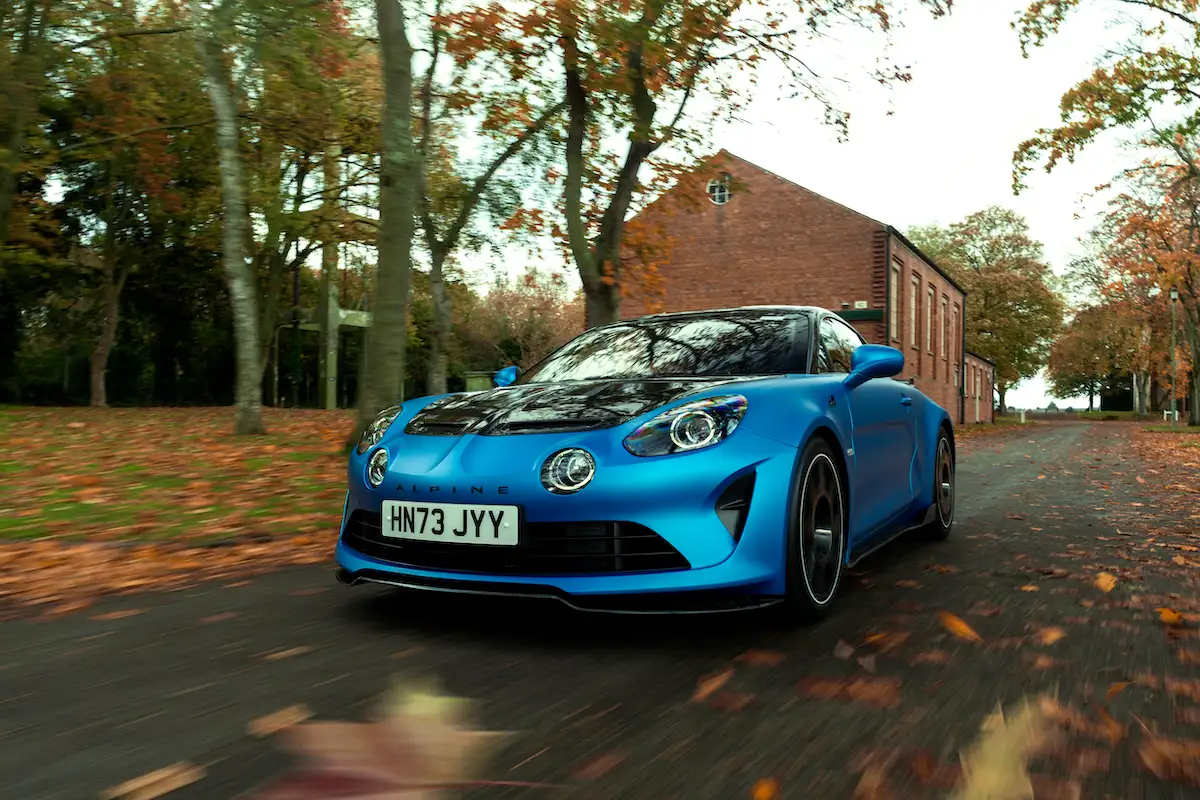
It took Land Rover two decades to decide that it should probably add an entirely new product to its offering, launching the Range Rover in 1970 not-so-hot on the heels of 1948's Land Rover. It could never happen today, as model line-ups swell with almost indecipherable differences.
Alpine has certainly given it a fair crack, though. The marque was revived by Renault as surprisingly long ago as 2012, unveiling a prototype that would all but become the Renault RS-01.
Three years later, in 2015, came the most likely car to launch Alpine proper: the Celebration. That was unveiled at Le Mans and two years later the near-identical A110 finally went on sale. At a push it’s nine years, at the very least it’s seven years, that Alpine has been keeping itself afloat on one model.
But what a model it’s been. It was instantly a class leader, and just as quickly won awards. It still does: it bagged Best Value Sports Car at the WhatCar? Awards this past January. Critics have been won over to the point where at least two top journalists have had them in their own personal garage.
But, like Land Rover before it, Alpine hasn’t sat still with its solitary offering, instead creating subtly different variants. That, it should go without saying, is where any similarities to Land Rover end.
Where the Land Rover went long-wheelbase and short, Ambulance and Station Wagon, Alpine’s various specials have rammed home its motorsport and automotive heritage. The 150-run Tour de Corse, matching the familiar yellow and black of the 1975 rally contender; the 200-run San Remo 73 to celebrate Jean-Luc Thérier's win; and the GT J Rédélé, to mark the 100th anniversary of the marque’s founder and limited to 100 units.
The most recent variant, the R, is surely the last before the A290 arrives, an electric hot hatch that will double Alpine’s range. The R is easily the most hardcore and the most likely A110 to find its way onto trackdays.
Beneath the bodywork might be the same Nissan-derived, Dieppe-fettled turbocharged 1.8-litre, but Alpine has found an extra 50bhp compared to the base model to hit 296bhp. On paper that is the same as the more focused S and GT editions, but here there’s far less to move around than with those two interim models. With carbonfibre at almost every turn, 34kg has been shed. The bonnet and wheels are both carbonfibre, helping the car tip the scales a full 20kg lighter than the S – more than half of that can be attributed to the wheels. Be sure to mind any kerbs.
For a modern car to be so close to 1000kg (officially it’s 1082kg) is nothing short of remarkable. It makes the R the first Alpine able to go from a standing start to 60mph inside four seconds (just).
The joy of the base-spec Alpine is its sheer accessibility of its remarkable abilities. Like the Elise a quarter of a century ago, it is not out-and-out speed craved here but any kink in the road. Alpine has not thrown that characteristic out with all the aluminium; it’s just different. The car is much, much more focused, and in turn so are you as you clamber into the bespoke bucket seat. From the clicking-in of the four-point harness you know things are serious. And that means the R isn’t going to be for everyone.
You’re pinned into the seat, barely able to move, and visibility is compromised forwards and anything past the back of your passenger’s head. The back window has been deleted for a carbonfibre covering that has been engineered to improve airflow – and save weight – and it has taken your rear quarterlight with it. So junctions can be an occasion.
Yet, should you find yourself fortunate enough to have an open road, you’re soon responding to every bit of feedback coming through that sublime chassis and cursing anything that hampers progress. It is addictive and absorbing in equal measure.
So many upgrades and so much carbon come at a price, though, creeping towards and, most likely, beyond six figures. It’s not quite Porsche GT4 RS territory, a car with more than 200bhp in hand over the R, but the fact that the German is nigh-on 500kg heavier makes it an intriguing comparison. Save £20k, and half a tonne? The scales balance out.
Certainly compared to the old GT4, pre-RS, the Alpine is nimbler, more responsive and more livable despite the Porsche having something that at least resembles a rear window.
The ultimate aim, perhaps, is for this to be a car driven to a track for a day working the Pilot Sport Cup 2 Michelins hard before driving home again and switching to the standard A110 the following day for your errands.
It’s bold, the A110 R, but it – and Alpine – carries it off.